
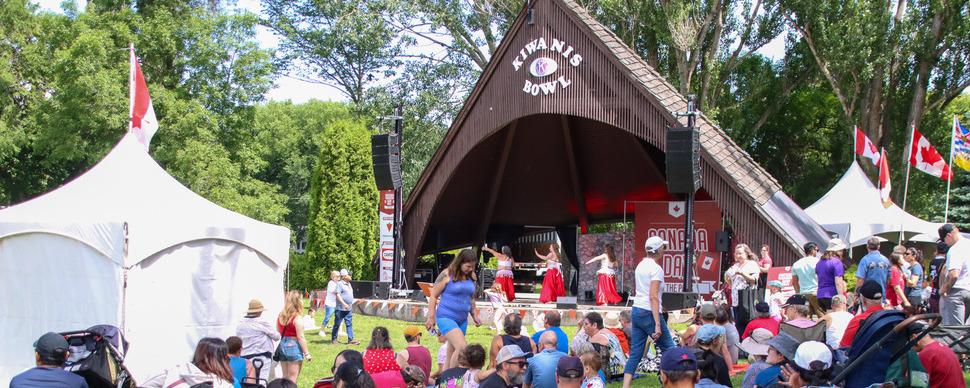
These guidelines can provide event organizers with an overview of some requirements, timelines, responsibilities, processes and considerations for hosting festivals, events, and tournaments in City of Prince George parks, sport fields, and civic spaces.
Event Planning
Applications for events will be accepted and evaluated on an ongoing basis. Please submit as early as possible. Requests made may be declined if there is inadequate time for proper planning and meeting details.
Documentation
Depending on complexity of event documentation is generally required well in advance of event including but not limited to:
- Signed Contract and Permit
- Insurance Certificate
- Site Plan
- Supporting documents, if required (risk assessment, security plan, Traffic Management Plan, etc.) .
- Permits (liquor, noise, etc.)
Fees & Payment
- Fees will vary depending on the facility requested, event duration and any additional services required for the event.
- Additional equipment and services costs may apply.
Cancellation
- Cancellations must be received in writing well in advance and refunds will not be considered after the deadline as indicated on the contract signed.
- Minimum $5 million Commercial General Liability (CGL).
- City of Prince George must be listed as an additional insured.
- Higher-risk activities (inflatables, fireworks, liquor service, drones) may require additional coverage.
- Event organizers should ensure the rental company or contractor for specialized service/activity provides a certificate of insurance (COI) naming them as an additionally insured party.
- Vendors and contractors need to have their own insurance also subject to the same minimum $5 million CGL and listing the City as an additional insured.
- Insurance can be purchased online or from any insurance company.
All parties booking an event on City property must have Commercial General Liability insurance in place. This requirement exists to address claims arising from circumstances under the event organizer’s control, such as event equipment, structures, or activities. If an incident occurs and liability is tied to the event, the organizer will be held responsible. If the organizer does not carry insurance and a claim is paid by another insurer, that insurer may investigate the loss and seek recovery of related costs from the responsible party.
Please review the Occupiers Liability Act for additional clarification on host responsibilities.
A site plan is recommended for all events. Event organizers are responsible for providing a site plan that illustrates all aspects of event. Maps can be created by using the City of Prince George mapping tool PG MAP available from our website or Google maps, whichever is preferred
The plan could include the following information, however, this is not an exhaustive list and may vary depending on the scope of the event.
Event Infrastructure:
- Tents and Fencing
- Food Trucks and Water Stations
- Dumpsters, garbage's and Porta Potty placements
- Seating areas
- Generators and other sources of electricity
- Placement of any vehicles and or trailers, including production and shuttle areas
- Stages, platforms, bleachers, other portable, prefabricated, or site-built structures,
- Inflatables, climbing walls, obstacle courses, games, petting zoo/animal rides, children/teen areas, sport demonstrations and other activities
- Other, as applicable
Event Operations
- Exits/Entrances, Emergency access points and 20ft emergency corridor through the site
- Activity areas
- Food, beverage vendor and merchandising areas
- Stages, production and entertainment areas
- First aid locations
- Volunteer/security stations
- Enclosed spaces (Ie. beer garden) identifying fence lines, entrances/exits and service areas
- Shuttle areas
- Other, as applicable
- Event organizers planning larger public events with anticipated attendees over 50 should complete a risk assessment and an event security plan.For public or outdoor events, WorkSafeBC and provincial guidelines recommend:
- Basic first aid kit for all events
- Trained attendants for high-risk or large events
- Onsite ambulance or medical services for major events (e.g., festivals, marathons)
Emergency Event Preparedness
Effective emergency planning is essential to ensure the safety of all attendees, staff, volunteers and participants during any event.
Complete the risk assessment webform above to evaluate attendance (people & crowd management), location, duration, activities and attractions, logistics (traffic, parking, etc.) and environmental risks to determine emergency needs.
- Identify and asses risks (impact/consequence vs. likelihood scale)
- Treatment options and plans
- Implement controls, mitigation measures and monitor
An event security plan ensures attendee safety and considers some core components depending on event and can include site and access control, security, emergency & contingency procedures, communication strategy and crowd management.
- Contact procedures (911, internal responders and safety team)
- Emergency supplies and roles/responsibilities
- Communication systems (PA, radios, SMS)
- Coordination with local emergency services and public safety
- First aid integration and staff training
- Evacuation routes and shelter locations
Outdoor Event Consideration: Include weather contingencies, lost person protocols, crowd control, emergency access, etc.
All events should have a clear, accessible Emergency Plan that is communicated to all staff and volunteer.
Fire Safety
- Fire hydrants must be always kept clear and unobstructed.
- The event must not block any access to fire department connections on any buildings.
- If any public roads or private access roads/parking lots are closed, provisions for emergency vehicle access must always be available. *Permit is required for any public road.
- The event permit holder must comply with all requirements of the BC Fire Code and Fire Protection and Emergency Response Bylaw No. 8272.
- Propane BBQ's are generally allowed in our parks with approval.
- Recreation fires are not allowed in a park or open space area except a wood fire in a outdoor fire pit provided by the City as per the City's Parks and Open Space Bylaw. No. 7370.
- No outside burning allowed during Air Quality Advisories. Please ensure compliance with the City's Clean Air Bylaw No. 8266. Any concerns or questions please call fire hall administration 250.561.7667.
- Events are encouraged to be accessible to people of all abilities.
- To make events accessible we encourage event organizer to consider barrier-free routes, viewing areas, and accessible washrooms.
- Encourage event organizers to ensure signage is clear and pathways are unobstructed.
- Complete full clean up and remove all equipment, garbage, and recycling.
- Report any incidents to the City.
- Provide feedback if requested.
- Recurring events are encouraged to submit a booking request for their preferred dates for the following year.
Utilities, Infrastructure, and Parking
The City of Prince George provides electrical and water access at designated event sites. Availability and service levels vary by location.
- Electrical hookups (200 Amp, three phase, 240 v) to civic power must be completed by City staff unless otherwise approved.
- All cords running along the ground should be covered.
- Generator use requires approval and should be safely cordoned.
- Water access may require backflow devices (available from the City with damage deposit).
- Water trucks can be rented locally and brought on site with City approval. The Event Organizer is responsible for coordinating this service and must reflect this location on the Site Plan.
- Water used for irrigating parks is not potable and is generally not available for event use.
- Driving vehicles on grass/turf is prohibited without written approval.
- Staking is not permitted in parks or on city land without prior approvals.
- Events impacting roads, sidewalks, or traffic require a Highway Right Of Way Occupancy Permit and a Traffic Management Plan (TMP).
- TMPs must follow the Provincial Traffic Management Manual which can be found on the BC Government’s Ministry of Transportation website. Category 3 TMPs must be prepared by a Professional Engineer.
- Notice of Traffic Disruption is required for all works/activities within a road right-of-way, where traffic control is required in accordance with the latest Provincial Traffic Management Manual for Work on Roadways, and the current requirements of WorkSafe BC.
- Parking options should be provided nearby when attendance exceeds on-site capacity.
- Parking on grass, or in pathways, driving lanes, fire routes, designated accessible spaces, etc., is not permitted.
- For larger events a parking plan is recommended and should include onsite parking management, identification of park and walk locations, shuttle plan with designated drop off and pick up zones, etc.
Depending on the size and location of your event, additional washroom facilities may be required. Provision, management, and associated costs for supplemental washrooms are the responsibility of the event organizer.
Several City parks have onsite washrooms available for use; availability will be confirmed during the application review.
Accessible washrooms should be considered.
General planning guidelines for events lasting longer than 3 hours with food and beverage service are:
- 4 toilets for 51–100 attendees
- 6 toilets for 101–200 attendees
- Add 1 toilet per 100 attendees beyond 1,000
- 2 handwashing stations is required, with 1 additional station per 10 toilets
Please ensure your site plan reflects the location, type, and quantity of all washroom facilities being provided
A good waste management plan can be a major contributor to a successful event.
Organizer Responsibilities
- Ensure there is enough garbage cans and dumpsters on site for size and duration of event.
- Manage all provided bins and permanent onsite bins during the event.
- Remove all garbage, recycling, and refundable bags post-event
- Ensure the event site is cleaned and returned to its original or better condition
- Any insufficient cleanup or damage may result in fees deducted from the damage deposit
- Ensure waste stations are accessible and clearly marked
- Most City parks do not have onsite dumpsters
- Organizers must arrange for dumpsters if required, including placement, drop-off/pick-up times, and coverage under event insurance (ensure coverage is for the entire time onsite from setup to teardown)
- Dumpster locations must be included in the site map
Sustainability Tip: Consider making your event green by implementing measures to reduce waste and environmental impact.
Food and Alcohol
- A City of Prince George valid business license is required to operate a Mobile Food and/or Sidewalk Vendor business within the City.
- Food vendors require Northern Health approval. Northern Health requires a temporary food permit for most food service at events. Please see the Northern Health website for more information and details regarding food permits.
- Food trucks must have valid business licenses and adhere to the Mobile Food and Sidewalk Vendor Business License Guide.
- It is the responsibility of food truck vendors to know their exact power requirements for their unit.
- Organizers are responsible for ensuring proper waste and grease disposal.
If alcohol is planned to be served at an event, it must be stated at the time of permit application and a letter of approval from the City needs to be requested.
- A Special Event Permit is required for serving alcohol. Please see the BC Liquor and Cannabis Regulation Branch website for more information and how to apply.
- Liquor service areas must be clearly fenced and staffed.
- Liquor liability insurance required.
- Provide the City a copy of the approved permit at least 2 weeks prior.
- City of Prince George is guided by and follows our Municipal Alcohol Service Council Procedure.
Additional Permits and Activities
- A Noise Permit is required for amplified sound.
- Noise must comply with the 7 am–11 pm restriction.
- SOCAN licensing is required for live or recorded music.
- Entertainment schedules (Run of Show) should be provided to key staff and volunteers.
- A Fireworks Permit is required for all events that plan to have fireworks. A Pyrotechnics Permit may also be required.
- Please see our fireworks rules for usage page for more information.
- Inflatables require BC Safety Authority operating permits.
- Event organizer must notify the City that a drone will be used during the event.
- Drone operators must apply for a Special Flight Operations Certificate (SFOC) from Transport Canada, regardless of device weight, including microdrones.
- Airspace Restrictions: Prince George has an airport (YXS) nearby, and strict rules prohibit flying within 5.6 km of an airport or 1.9 km of a heliport without NAV Canada authorization.
- If/when granted authorization by Transport Canada, the event organizer must provide the City with evidence that their insurance covers the use of a drone and any liability arising from its use.
Appendix
The following dates have limited capacity for special events:
- Canada Day – July 1 (Lheidli T’enneh Memorial Park)
- BCNE – Mid–Late August (Exhibition Grounds & Kin Centre)
- Civic Light Up – Last Friday of November (Civic Plaza)
- May to September generally high-volume season
Events are subject to and need to abide by all City of Prince George Bylaws
- City of Prince George Noise Control Bylaw No. 8940
- City of Prince George Smoke and Vape Free Places Bylaw No. 8591, 2016
- City of Prince George Parks and Open Space Bylaw No. 7370
- City of Prince George Comprehensive Fees and Charges Bylaw No. 7557 for more information regarding the fees and charges for use of City owned venues.